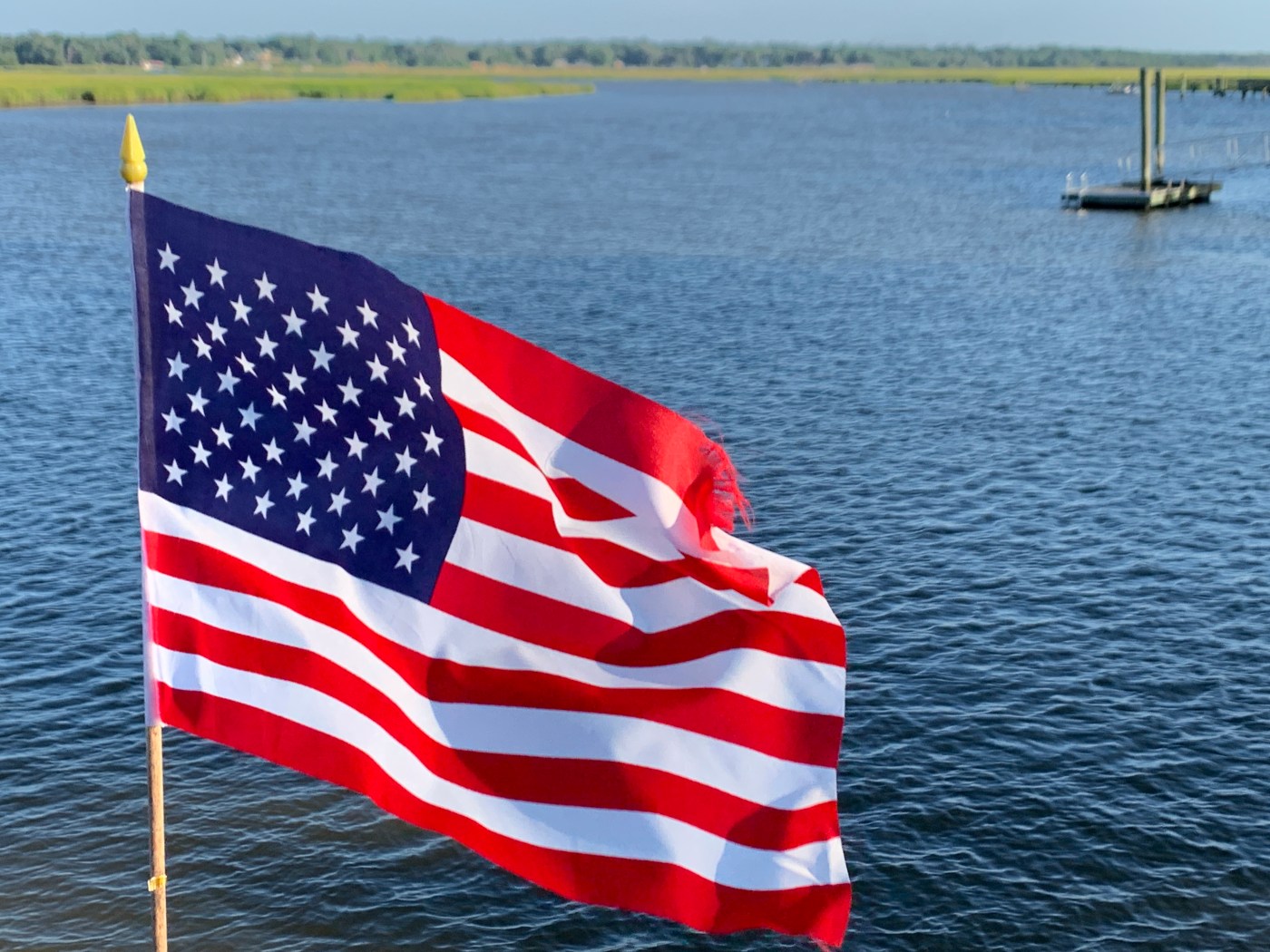
Are we living in unprecedented times? Perhaps 2020 will be one for the history books, but as we prepare to observe America’s 244th Independence Day, I’m reminded that our country was forged from unrest and revolution and that my hometown, Savannah, Georgia, was right in the middle of it all.
The founders of our nation were revolutionaries. Three of them were the Georgians who signed the Declaration of Independence in August 1776, about a month after it was adopted by the Continental Congress on July 4th. Button Gwinnett, whose grave is in Savannah’s Colonial Cemetery, traveled with George Walton and Lyman Hall 700 miles to Philadelphia to represent the newest and most remote of our country’s 13 original colonies. When they added their signatures to the Declaration, they were immediately branded as traitors in the eyes of our British rulers.
Even though Savannah was only 40 years old at the time, our English heritage was already ingrained in the fabric of our community and in many ways, it remains so to this day. Savannahians still say “whit-field” and “whit-marsh” when we talk about Whitefield Square and Whitemarsh Island. Streets named during the Colonial period are likely still pronounced much the same as they were back then. You can often tell who the newcomers are because they mispronounce “BAR-nard” and “HOUSE-ton.”
Yet, in the aftermath of the American Revolutionary War, Savannah purposefully disassociated from its colonial past. All anyone has to do is stroll through downtown Savannah to see the evidence. Did you know that State Street was once named Prince Street and President Street was originally King Street? Others such as “Congress” and “Liberty” are further proof that Savannah was at the center of our country’s hard-won fight for freedom.
There are certainly some Revolutionary battles better known in our history books, but the siege of Savannah in 1779 is worthy of more than a footnote. It’s a vivid illustration that Americans were united, but moreover, that we were not alone in our fight for freedom.
This particular battle consisted of a joint Franco-American attempt to retake Savannah from British occupation and included more than 500 recruits from Saint-Domingue, a French colony that later would become Haiti. They fought alongside American colonial troops against the British Army during the siege. Also, during that attack, Polish nobleman Count Casimir Pulaski, who led the combined cavalry forces on the American side, was mortally wounded. Although the joint attack failed and the siege was abandoned, allowing the British to remain in control of Savannah until July 1782, it was considered one of the most significant, foreign contributions to the American Revolutionary War.
The siege of Savannah was also one of the bloodiest, a reminder that revolution does not come without cost. While Franco-American losses were originally estimated much higher, the actual tally of 244 killed, nearly 600 wounded and 120 taken prisoner, was severe enough. British casualties numbered 40 killed, 63 wounded and 52 missing.
So, as we observe this Independence Day, let’s remember the sacrifice and loss that led to our freedom. But, let’s also celebrate the journey that is America and be thankful that former enemies can heal the wounds of war and put the past where it belongs.
Savannah, itself, is a visual history lesson and a powerful reminder that our country was forged from unrest and revolution. The struggles of our past have melded us into who we are today. The revolution continues to test us. In doing so, it strengthens us.
Happy Independence Day!
 Carmel Hearn
Leave a comment